Case study
Building a site for modern search, and getting cited within weeks
I built the SEO Handbook for search as it works now: zero-click answers, LLM retrieval and citation. AI answers were citing it within three weeks of launch. Five months in, it had 36.6k impressions in Google's AI features, 9.7k citations in Microsoft Copilot and partner answers, and was a source in Google's AI Overviews for searches such as "white hat seo" and "search engine position tracking".
Results
- 36,000+ Impressions in Google's AI Overviews and AI Mode, May to October 2026
- 9,700+ Citations in Microsoft Copilot and partner AI answers, May to September 2026
- 2,000+ Verified ChatGPT fetches, September to October 2026
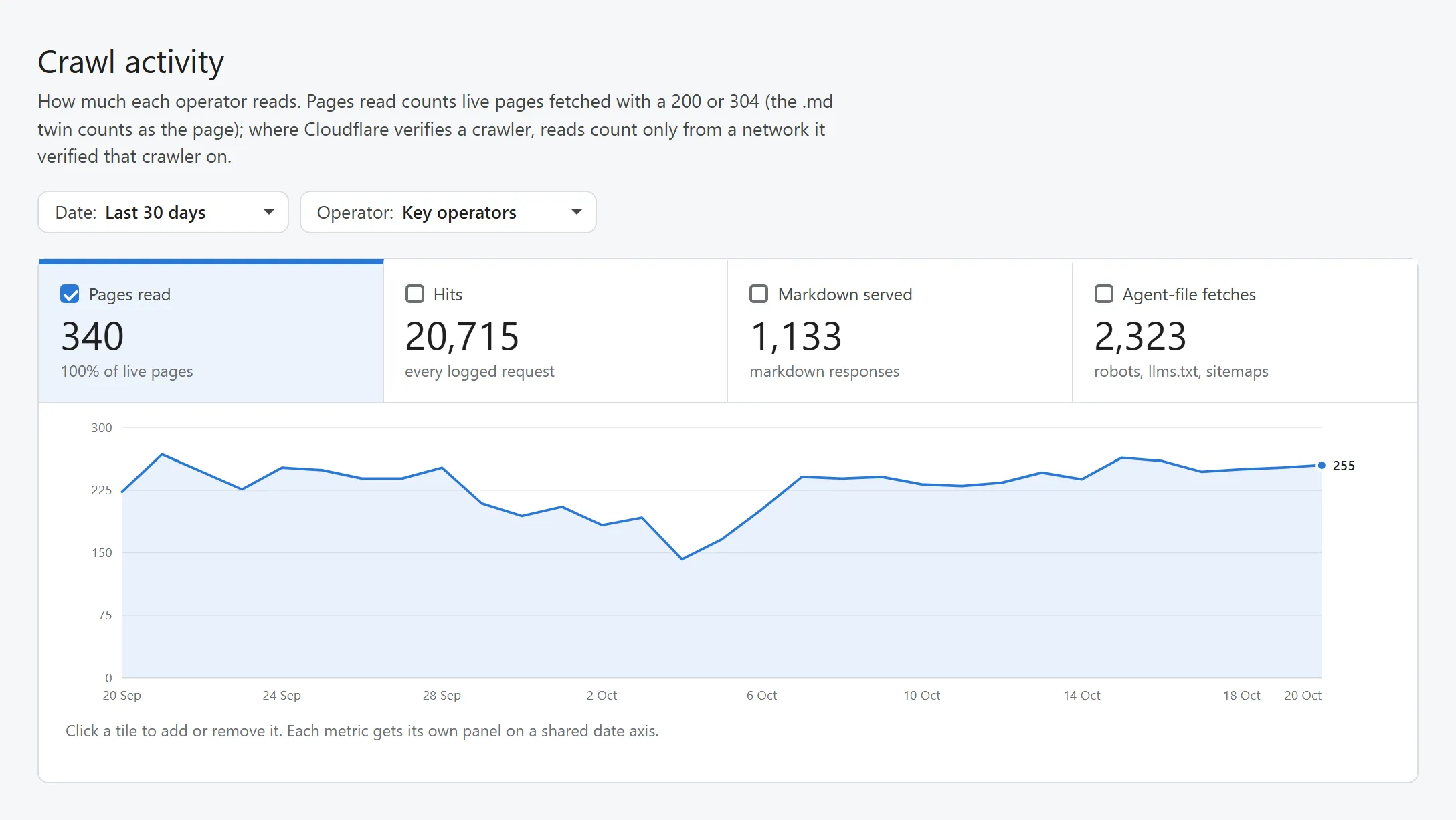
- 20,000+ Verified AI crawler fetches in 30 days, September to October 2026
- 1M+ Google search impressions, May to October 2026
Sources: Google Search Console, Bing Webmaster Tools AI Performance and the site's own server log, May to October 2026.
The brief
The SEO Handbook is a reference site of over 300 pages on technical SEO, keyword research, analytics and AI search, launched in May 2026. It is built for search as it works now: questions answered without a click, LLMs retrieving pages to build their answers, and citations as the credit. The aim is well-sourced, helpful content that answers real questions about search, in a form those systems can retrieve and cite.
It was also an experiment in working with AI. AI helps draft the copy and build the site, working from my outlines, notes and sources; the topics, claims, fact-checking and SEO decisions are mine. I wanted to see where AI fits alongside SEO experience, on a site large enough to test it.
It builds my own entity too: the version of me that search engines recognise as one specific person, rather than a name shared with anyone else called Liam Hayward. Every article names me as its author through a single Person entity in the schema markup, the same one liamhayward.co.uk uses, which ties the handbook's work to me.
The work
No AI provider publishes a recipe for being cited, so the work combined what the platforms document, experiments of my own, and the SEO fundamentals underneath both.
What the platforms document
- All content in the static HTML, readable without JavaScript
- Explicit rules allowing AI search crawlers in robots.txt
- Precise claims, each with a named source
- Self-evident authorship: one named author, tied to a single Person entity in the schema
- A public disclosure of how AI is used
- Concise, self-contained answers, starting with a TL;DR on every knowledge-base article
Experiments
- A Markdown version of every page, served to agents that ask for one
- An llms.txt file describing the site for AI systems
SEO fundamentals
- Helpful, people-first content that answers real questions about search
- Articles kept current, with visible update dates
- A clear technical structure
- Topics organised into pillars and clusters
- Contextual internal links between related pages
- A site that loads fast and is easy to crawl
Measuring it
Rankings and clicks measure the results page, and an AI answer that cites a page often sends nobody to it. The evidence had to come from three other places: the platforms' own AI reports, third-party tools that record which sources an AI answer cites, and the server, which sees every AI assistant that fetches a page. In August I built a first-party crawler log on the site's own Worker. It records which crawlers and AI assistants fetch which pages, checked against Cloudflare's list of verified bots, and stores no IP addresses or cookies.
Where it showed up
- Google first showed the handbook as a source in AI Overviews and AI Mode within three weeks of launch, and by the end of May it was appearing in them every day. Over a million search impressions from May to October, 36.6k of them in AI Overviews and AI Mode. In June, AI features made up about 1% of the site's Google impressions; by October it was over 8%. From June to September, AI impressions grew more than sixfold while ordinary impressions grew by about a quarter.
AI Overviews and AI Mode as a share of the handbook's Google impressions, 2026
Source: Google Search Console, generative AI and Performance reports. October covers 1 to 19 October. - Bing
- 9.7k citations in Microsoft Copilot and partner AI answers from May to September. Over the same months the site appeared in Bing's ordinary results fewer times than that: it was cited in AI answers more often than it was shown in search results.
- Ahrefs
- In October 2026, Ahrefs recorded the handbook as a source in Google's AI Overviews across the UK, the US, India, Canada and France, for searches such as "white hat seo", "search engine position tracking", "people also ask boxes" and "rich results".
- ChatGPT
- In 30 days from late September, ChatGPT's user fetcher, which fetches a page when a conversation needs it, made over 2,000 verified fetches across more than 200 handbook pages.
- Other AI crawlers
- Over the same 30 days, AI crawlers made over 20,000 verified fetches of the site, from OpenAI's search crawler, Anthropic, Meta, Amazon, DuckDuckGo's AI assistant and Exa, an AI search engine built for agents. Claude fetched pages for live conversations over 200 times, and Exa took almost every page as its Markdown version.
- Clicks and rankings
- Clicks grew every month from June to September, more than tripling. Between June and October, the number of searches where the handbook ranked on page one more than doubled, and the number in the top three grew almost fivefold.